
Tolkien Memorial in Poets' Corner
Westminster Abbey has recently announced that J. R. R. Tolkien is to be commemorated in Poets’ Corner.
A major new memorial celebrating Tolkien’s creative imagination and storytelling, designed by the artist Stephen Broadbent, will be unveiled at a dedication ceremony in spring 2027.
The inspiration and development of the memorial design has also involved a wide group of Tolkien scholars, including several members of the Oxford Tolkien Network.
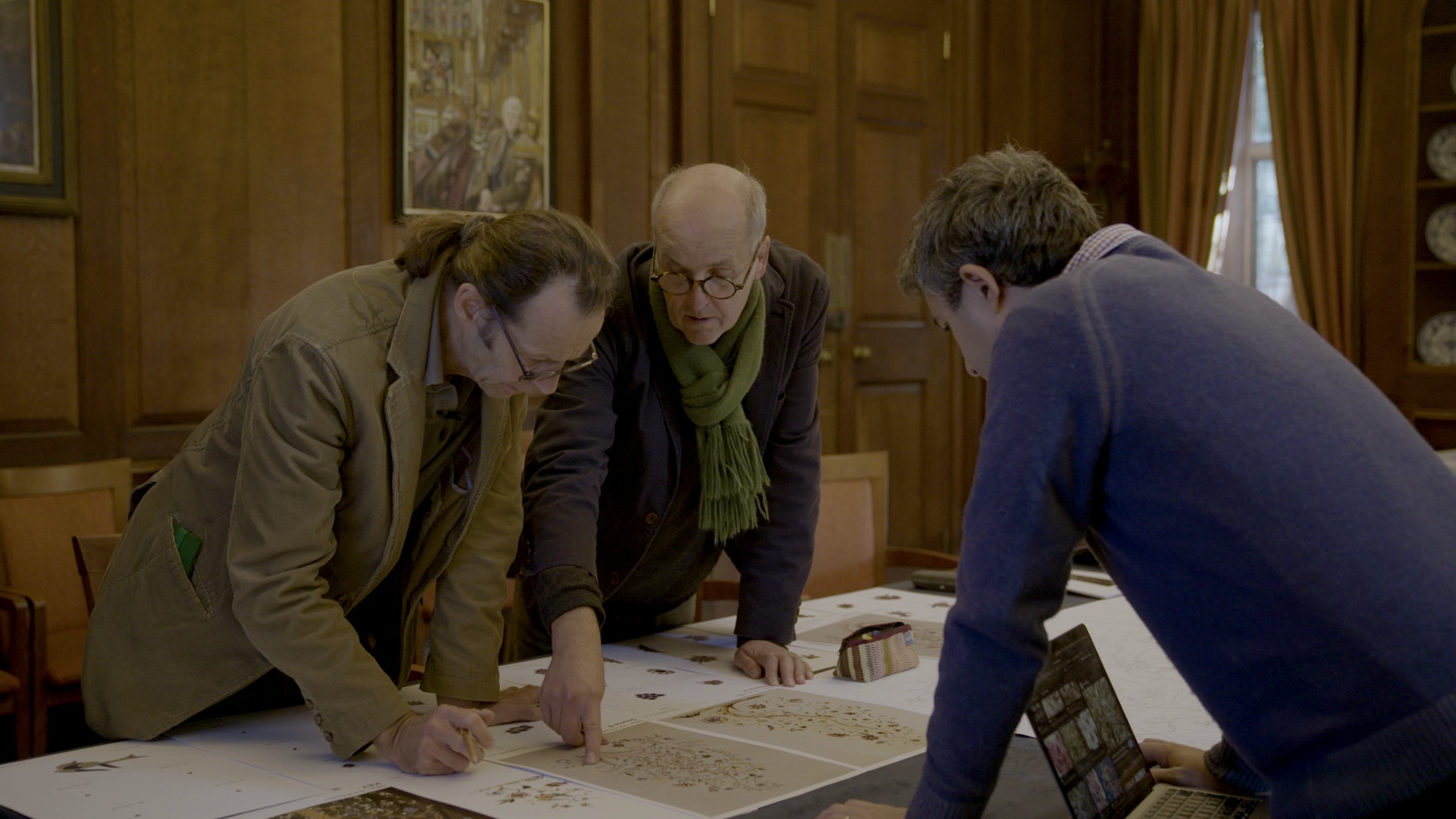
Research on the Tree of Amalion: Giuseppe Pezzini, Stephen Broadbent, and Peter Davison: Credit Mike Taylor
Below you can find an interview originally published on the TolkienGuide website with Prof. Giuseppe Pezzini, who has been involved in the project since its inception, together with several other colleagues.
- What was the catalyst for creating the memorial, and why are memorials like this still important in the 2020s? Poets’ Corner contains memorials and the remains of some of Britain’s greatest writers and poets. Why does Tolkien deserve to be memorialised alongside them?
The idea of the memorial was first put forward by Lord Alton and embraced by the Abbey, with the generous support of the Tolkien Estate: the decision about who should be considered rests with the Dean of Westminster advised by its Fabric Commission, but I think there was a general feeling in the Abbey that the time was right for a Tolkien Memorial in Poets’ Corner. Memorials are still important not as ways of imposing canons or narratives, but simply as ways of acknowledging realities. And indeed, in this case, the desire was simply to acknowledge and commemorate what has already been a reality for many years: J.R.R. Tolkien belongs among the greatest writers of English literature – and indeed of world literature at large. His works have been translated into more than 50 languages and are among the most successful literary works ever written, beloved by millions of people from many different backgrounds, with a cultural reach and influence, still ongoing, that is difficult to parallel, and a growing recognition in the academic world – despite some initial biases and resistance (nowadays mostly outdated). There is something very Tolkienian about all this: that the great things of history happen gradually, over a long period of time and “in the dark in some forgotten corner” (Carpenter #79: Letter from J.R.R. Tolkien to Christopher Tolkien • 22 August 1944 (#168)), often while everyone else is looking elsewhere; and that what is most particular (like Tolkien’s very idiosyncratic, very English literature) is quite often revealed to be the most universal.
- What space were you allocated by the Abbey, and what was the design brief to fill that space? Apart from the Tolkien Estate, who else was involved in the design brief?
As explained in the Abbey’s press release, the memorial will be inlaid vertically within a stone pillar in the south transept of the Abbey and will stand 2.5 metres high. I was involved in developing the original design brief together with my colleagues and dear friends, Anton' de Piro from the Christian Heritage Centre at Stonyhurst and Rebekah Lamb from the University of St Andrews. Early on, it became clear that a monument to J. R. R. Tolkien, such as a bust or a statue, would not have been very Tolkienian, hence the desire to suggest something that would embellish the Abbey, something beautiful and thought-provoking that would allow people to engage with Tolkien’s idea (and experience) that ‘fantasy’ is not an escape from reality but a way to recover wonder and a deeper perception of truth. More than 20 scholars were consulted at this initial stage on the form this vision might take, a vision eventually embodied in the image of the Tree of Amalion, which Tolkien drew several times. It is recognisable as a tree but is more an expression of imagination than a realistic rendering. Looking closely, one can see that its fruits and flowers are all different from one another – an impossibility in nature – yet it looks like a living tree, in which differences are miraculously harmonised and integrated into a whole, like different voices in a single polyphonic concert. The image can also be associated with Tolkien’s notion of the Tree of Tales, described in his essay On Fairy-Stories (whose “countless foliage” is ever enriched by new legends, myths and stories) and with the King’s Tree in Smith of Wootton Major (which “bore at once leaves and flowers and fruits uncounted, and not one was the same as any other that grew on the Tree”). Tolkien also applied the image of the Tree to his own writing, comparing The Lord of the Rings to his “own internal Tree”—the same Tree, one might add, that Niggle imagined “with all of its leaves in the same style, and all of them different”, and which eventually became real, to his wonder, with “astonishing birds” settling on its “innumerable branches”. Other scholars and experts joined the project as it developed, including Professor Walter Judd, who contributed his expertise on the flora of Middle-earth. The initial concept was embodied and developed through Stephen’s visionary art, and the passionate and talented team at the Abbey, with the support and creative input of the Tolkien family and the Tolkien Estate, worked closely with him over the years to create the beautiful final design.
- Who is the sculptor? How was the sculptor selected, and are they a fan of the Professor’s works?
The sculptor is Stephen Broadbent, one of the great artists of this generation and the creator of many remarkable works around the country, among which I would single out the extraordinary Pilgrim Porch at Chester Cathedral. He was selected, of course, for the beauty, vision, and depth of his art, but also for the humility with which he proposed to engage with the space of the Abbey in a way that is creative yet respectful and organic, and indeed for his deep love for, and affinity with, Tolkien’s creative vision. Stephen stood out as an artist with a genuine understanding of Tolkien, Westminster Abbey, and the significance of Poets’ Corner. He has the wisdom to work collaboratively and to listen, but also the confidence to articulate a vision. He understood that, while the work of art must have a manifest presence, be an ornament to the fabric of the Abbey, and be capable of inspiring interest and a sense of Tolkienian wonder, it must also be sufficiently unobtrusive not to assert itself impertinently (Art, not Power). Finally, Stephen Broadbent is motivated by a desire to create a memorial artwork that reflects, in a small way, the great gift of Tolkien’s storytelling through the very best of Art and Craft design. All these qualities strike me as distinctly Tolkienian.
- What materials are used in the memorial, and roughly how long has it taken to create?
This is really a question for the artist, and in any case I am sure he would not like to disclose all this information at this stage – because, as Gandalf says, “Many folk like to know beforehand what is to be set on the table; but those who have laboured to prepare the feast like to keep their secret; for wonder makes the words of praise louder.” What I can say, following the Abbey’s press release, is that it will be made mainly from native woods found in the UK, including a piece of Tolkien’s iconic black pine from the Oxford Botanic Garden, and will draw upon the finest British craftsmanship.
- How has the fact that Tolkien was a devout Catholic influenced the decision for him to be memorialised in an Anglican cathedral? Do you think he would approve of this, and was a memorial in Westminster Cathedral considered instead?
There are already several other great Catholic writers memorialised in the Abbey, including John Dryden and Alexander Pope, as well as Gerard Manley Hopkins and Oscar Wilde. And, of course, there are also memorials in the Abbey to non-Christian writers and thinkers. I am sure that Tolkien would have approved of this. His strong Catholic faith, “bought by the martyrdom” of his mother and informing his creative vision as well The Lord of the Rings, (which he described as “a fundamentally religious and Catholic work”), was not exclusive, divisive, or identitarian, as Christianity is unfortunately often thought of nowadays. He had many close friends who were Anglican, among them, of course, C.S. Lewis, whose encouragement was crucial to the writing of The Lord of the Rings. His passionate love of art and literature resisted any reduction of Art to moral, philosophical, or theological catechesis, and transcended cultural any religious boundaries and appropriations, In this sense, he had a sensitivity very similar to that which informs the vision of Poets’ Corner in Westminster Abbey.